
Soft fruit is grown differently to most other crops Sitetech works with, and it is watered differently too. Strawberries, raspberries and blueberries are commonly grown in substrate rather than open ground, on table-top systems or in tunnels, with root zones that hold very little water in reserve and need feeding as well as watering, almost continuously through the season.
We design and install soft fruit irrigation for strawberry, raspberry and blueberry growers, built around table-top and substrate growing, tunnel protection where it is used, and fertigation, since soft fruit on substrate depends on it rather than treating it as an optional extra.
"*" indicates required fields
Soft fruit grown in substrate, whether that is coir, peat-based media or another growing medium in bags, troughs or pots, holds far less water in reserve than open ground. That means strawberry irrigation, raspberry irrigation and blueberry irrigation all have to run more precisely and more frequently than irrigation on soil-grown crops, with much less margin for error if a zone runs dry or a dosing rate drifts.
It also means soft fruit irrigation is rarely just irrigation. Because substrate holds so little nutrient reserve of its own, feeding through the line is standard practice rather than an add-on, and getting the balance of water and feed right, cycle by cycle, is central to how the crop performs. We design soft fruit irrigation systems around that reality from the outset.

Table-top growing raises the crop, usually strawberries, off the ground onto raised troughs or gutters, which makes picking easier and keeps fruit away from soil-borne problems. It also changes the irrigation brief: each trough or gutter run needs even delivery along its length, and because the growing medium volume is small, watering and feeding cycles tend to be shorter and more frequent than in-ground growing.
Substrate growing in bags or pots for raspberries and blueberries has similar demands, precise delivery to a limited root volume, with little buffer if a dripper blocks or a zone is misjudged. We design drip layouts for table-top and substrate systems with even distribution along every row as the starting point, since an uneven system shows up quickly in a crop with this little margin for error.
A good deal of UK soft fruit is grown under cover, in polytunnels or similar structures, to extend the season and protect the crop from weather. Irrigation inside a tunnel behaves differently to irrigation in the open, warmer, more sheltered conditions change demand, and the tunnel environment needs to be part of the irrigation design rather than treated the same as an outdoor planting.
Where soft fruit is grown in tunnels, we design the irrigation and fertigation together with the tunnel environment in mind, covered in more detail on our polytunnel irrigation systems page. Table-top strawberry and substrate raspberry and blueberry systems commonly run this way, drip-fed rows inside tunnel structures, on a system sized to the tunnel’s own conditions rather than a generic outdoor design.
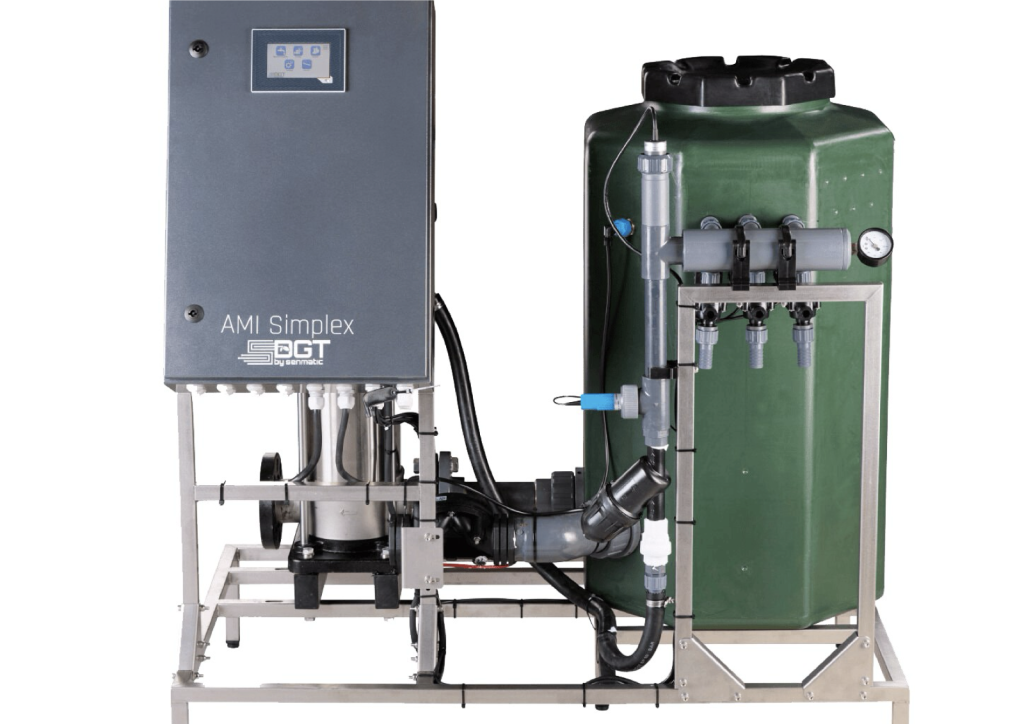
Soft fruit grown on substrate depends on fertigation in a way that many other crops do not. With so little growing medium holding so little nutrient reserve, feed has to arrive through the irrigation line on a regular, reliable schedule, and getting the EC and pH of that feed right matters more than it does in open ground, where soil provides some buffer against small errors.
We design fertigation systems for soft fruit growers using DGT and AMI equipment (Sitetech is the main UK distributor for DGT by Senmatic), specified so dosing and monitoring match the precision the crop needs. See our DGT and fertigation equipment page for more on the equipment itself. For soft fruit specifically, we treat fertigation as part of the core design from the first conversation, not something added once the irrigation is already decided.
Soft fruit sites vary a good deal, table-top strawberries under tunnels, substrate raspberries in open polytunnels, blueberries in containers outdoors, and each combination needs its own design rather than a standard layout. We start with a site visit to look at the growing method, the tunnel or open-air setup, the water source and the feed regime the crop needs.
Because table-top and substrate systems have so little margin for error, sizing zones, dosing rates and filtration properly is a site-specific job, not something we can estimate without seeing the layout. The site visit answers those questions, and the specification follows. If you also grow other crops on the same holding, we can design nursery irrigation or orchard and vineyard irrigation alongside your soft fruit system, or get in touch via our contact page to talk through your site specifically.
For an example of this work in practice, see our soft fruit irrigation case study.
We’re a family-run Lancashire firm working with growers across the whole of the UK and internationally. Design, supply, installation and aftercare come from the same small team: the person who designs your automatic watering system is the person who answers the phone if a valve plays up. No call centres, no handoffs.
Tell us about your site and what you grow, and we will design the system around it. Call Simon on 07881 271 117, email simon@sitetech.uk, or use the button below to arrange a design visit.
Drip irrigation is standard for soft fruit, whether grown in open ground, on table-top systems or in substrate bags and pots. Because root zones hold little water in reserve, especially on substrate, delivery needs to be even and reliable along every row, which is why we design each layout to the specific growing method rather than a generic drip system.
Table-top growing raises the crop, usually strawberries, onto raised troughs or gutters off the ground. Because the growing medium volume in each trough is small, irrigation and feeding cycles tend to be shorter and more frequent than in-ground growing, and even delivery along the length of each row matters more than it does at ground level.
The principles are similar, precise drip delivery matched to a small growing medium volume, but strawberry, raspberry and blueberry growing methods (table-top, substrate bags, containers) differ enough that layouts are rarely interchangeable. We design strawberry irrigation, raspberry irrigation and blueberry irrigation around the specific growing method used on your site.
For substrate-grown soft fruit, fertigation is standard practice rather than optional, since the growing medium holds very little nutrient reserve on its own. Feeding through the irrigation line keeps the crop fed on a reliable schedule matched to watering, which is far harder to achieve consistently with separate hand-feeding on this kind of system.
Yes, this is one of the most common soft fruit setups we work with. Tunnel conditions affect watering demand, so we design the irrigation and fertigation together with the tunnel environment in mind. See our polytunnel irrigation page for more detail on how tunnel growing changes the design.
It depends on the growing method, the number of zones and whether fertigation and tunnel protection are part of the system, so we do not quote a standard figure. Every soft fruit site is different, and a site visit lets us understand your setup properly before we put together a specification and quote.