
Overhead sprinkler that delivers uniform water distribution, support healthy crops, reduce water waste, and enhance growth for gardens, greenhouses, and farms alike.
"*" indicates required fields
A carefully planned watering strategy is crucial for gardens, greenhouses, and large-scale farms. Our overhead sprinkler irrigation system ensures consistent coverage, promoting crop health, conserving water, and improving soil quality. By targeting each area efficiently, plants receive the right amount of moisture, reducing runoff and ensuring sustainable irrigation practices for every growing environment.
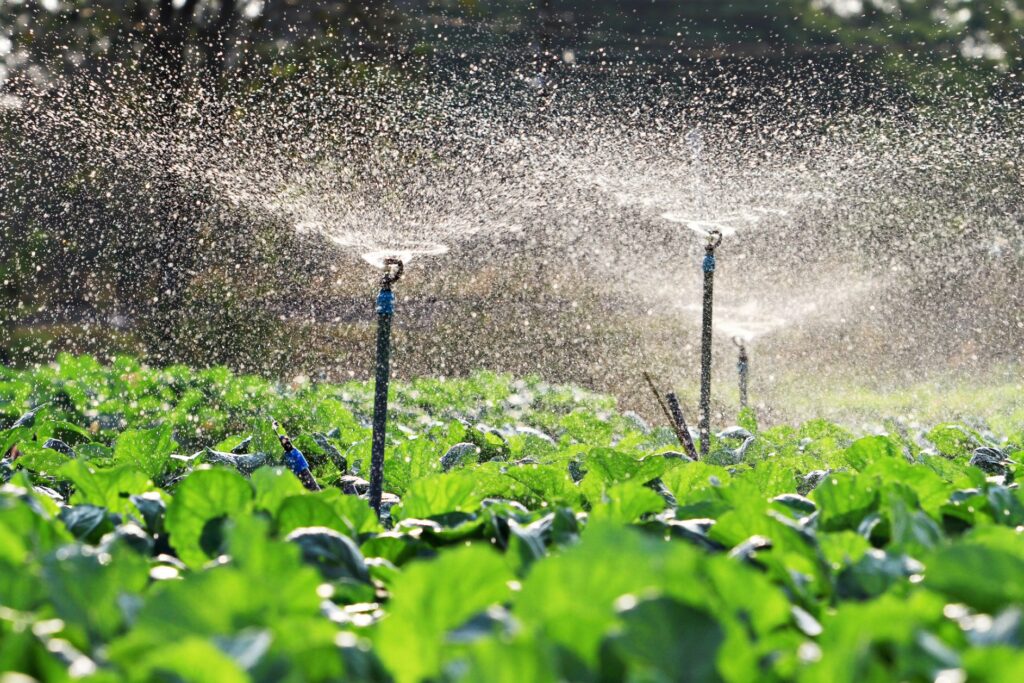

We customise each overhead sprinkler irrigation system for greenhouse and farm applications, ensuring efficient water use and maximum crop output.
Every design accounts for terrain, crop type, and water availability, preventing water waste and optimizing coverage.
Systems can integrate with timers, sensors, or automation tools for seamless irrigation management.
Our team provides guidance from initial design to ongoing maintenance, ensuring your overhead sprinkler system performs at peak efficiency.
Our overhead sprinkler for greenhouse, gardens, and farms includes durable materials, flexible layouts, and energy-efficient operation for reliable performance.
These features simplify maintenance, allow for future upgrades, and ensure consistent watering across every crop type.

Field-scale growing brings a different set of problems to solve than a walled garden or single glasshouse bay — long pipe runs, variable ground levels, and pressure that has to hold up across a much bigger area. We design farm irrigation sprinkler systems specifically for that scale, working out pipe routing, pump sizing and sprinkler spacing so coverage stays even from the first row to the last.
Large-area irrigation sprinklers need to be matched to the site, not just bought off a shelf — wind exposure, soil type and crop rotation all affect spacing and head selection. Our design process starts with a site visit so we can size the system to your actual land and water source, rather than a generic template.
Installation for farm-scale sprinkler systems is planned around your growing calendar, so fieldwork isn’t disrupted any more than it needs to be, and the system is ready before it’s needed. For how automation fits into field-scale watering, see our guide to smart irrigation systems for modern UK farms.
We supply and install commercial irrigation sprinklers as complete engineered systems — heads, pipework, pumps and control together — rather than components on a pallet.
A sprinkler system is only as good as its installation and the care it gets afterwards. This is how an install generally runs, and the routine we recommend to keep coverage even year after year. For the design side, see our guide to sprinkler irrigation design for farms.
We walk the site to check layout, levels, water source, power, existing pipework and anything that will affect pipe routes or head positions, such as structures, gateways and crop rows.
Zones, pipe routes, head spacing, pump and controls are drawn up around your crop and water supply, and agreed with you before ordering.
Installation is planned around your growing calendar, so groundwork and pipe laying disturb crops as little as possible.
Mainlines and laterals are laid and joined, with isolation valves, air release and drain points built in where the design needs them.
Sprinkler heads and nozzles are fitted to the design, then the pump, filtration and controller are connected.
Lines are flushed to clear installation debris, then the system is pressure tested and checked for leaks.
Each zone is run, pressure is checked at the pump and at the furthest head, and the spray pattern is watched for even overlap.
Your team should be shown how to operate the controls and what to check routinely.
Ask for the commissioning readings (pressure at the pump and at the end of each zone) as part of handover. They are the baseline every later check is compared against.
Spring start-up
In-season checks
Autumn shutdown

This system is suitable for gardens, greenhouses, and commercial farms, delivering consistent irrigation while saving water and improving plant health. Perfect for:
All applications benefit from professional design and installation of sprinkler irrigation system solutions for maximum efficiency and longevity.
Decades of experience in farm and greenhouse irrigation ensure our systems are dependable and effective in all conditions.
Every sprinkler irrigation design for farms is custom designed to meet your operational needs, ensuring optimal performance and coverage.
We use premium materials and trusted technology to reduce maintenance and extend system life.
From planning to setup and ongoing optimization, our team provides comprehensive support for lasting irrigation performance.
Ready to implement an overhead sprinkler?
Contact our experts to plan, design and install a sprinkler irrigation system solution that maximizes water efficiency, enhances crop growth, and delivers long-term results.
We are based in Lancashire and provide surveys, installation and aftercare for growers across the UK. Designs are based on crop spacing, pressure requirements and future expansion, so a farm can scale without reworking its infrastructure or losing uniform coverage. For extensive farms, large area sprinklers are designed to give broad, even coverage without dry patches. We handle everything from consultation to commissioning, so you work with one provider rather than several contractors.
After installation we provide training so operators know how to manage the controls, carry out basic checks and recognise early signs of trouble. Ongoing maintenance, seasonal checks and performance adjustments help avoid unexpected downtime. Replace nozzles when uniformity checks show uneven coverage, or when a worn nozzle looks visibly enlarged next to a new one. Doing it zone by zone keeps application consistent, and checking before the main season beats finding the problem mid-crop.
The systems are designed with efficiency in mind, helping reduce water use, energy consumption and runoff. Our servicing and maintenance page explains how we keep systems working.
Yes, we assess your site, crops, and water source before recommending a solution, ensuring suitability, compliance, and long-term efficiency rather than pushing standard systems that may underperform in real conditions.
Yes, we can upgrade or modify existing irrigation layouts, replacing inefficient components and improving performance while minimising disruption to crops, schedules, and day-to-day farm operations during peak growing seasons locally.
We size a sprinkler system from the area and shape of each block, the crop’s peak water demand, the water and pressure available at the source, and how much time there is to irrigate each day. Those decide the sprinkler and nozzle choice, the spacing, and how the area is split into zones, so every zone gets even coverage within what the pump and supply can deliver. We confirm the design on site before anything is ordered.
Running effort depends mainly on the energy the pump uses, how well the system is matched to your water supply, and how evenly it waters. A well-designed system with the right nozzles, sensible zoning and automated scheduling applies only what the crop needs, which keeps pumping time and water use down. We assess each site and quote the actual system, so you know what is involved before any work starts.
Yes, our overhead sprinkler systems work well as a complete greenhouse watering system, delivering uniform coverage across every bench and growing area while adjusting flow and coverage to suit different crops, layouts, and growing stages reliably. Add a controller and solenoid valves and it becomes an automatic greenhouse watering system. For how overhead, drip and other methods compare in a glasshouse, see our greenhouse irrigation systems.
Run a catch-can test: place identical containers in a regular grid across a zone, run the system for a set time, then compare how much each collects. Big differences between containers point to worn nozzles, pressure problems or blocked heads, and the pattern of where the shortfalls fall usually tells you which.