
Related service: Smart irrigation technology
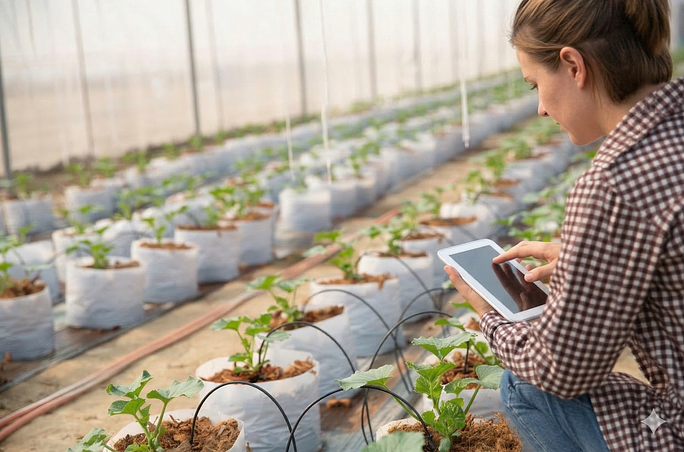
Farming has always been a data-driven enterprise – reading the weather, assessing soil conditions, understanding crop requirements at different growth stages. What has changed is the quality, quantity, and accessibility of the data available, and the sophistication of the systems that can act on it.
Smart irrigation control systems represent the convergence of these developments. They take the fundamental challenge of agricultural water management – delivering the right amount of water, to the right place, at the right time – and apply sensor technology, connectivity, and automated control to address it with a precision that manual or timer-based irrigation simply cannot approach.
For tech-forward farmers in the UK who understand that water efficiency is both a commercial and an environmental imperative, this guide covers what smart irrigation control actually delivers, how the technology works, and what the genuine return on investment looks like across different farming contexts.
The Problem With Conventional Irrigation
Before examining what smart irrigation does, it is worth being precise about what conventional irrigation does not do – because the commercial and agronomic costs of inadequate water management are frequently underestimated.
Timer-based irrigation systems deliver water on a fixed schedule regardless of actual conditions. They cannot account for the rainfall that occurred overnight, the cooler temperatures that reduced evapotranspiration yesterday, or the fact that one section of the field is on heavier soil with significantly higher water-holding capacity than the rest. They apply the same volume of water on a dry July afternoon as on a cloudy April morning when the crop’s water demand is a fraction of the summer peak.
The consequences of this bluntness are both agronomic and financial. Over-irrigation leaches nutrients below the root zone, reduces soil aeration, promotes root disease, and in some crops directly reduces quality and yield. It also generates costs – in water abstraction charges, energy for pumping, and the agronomic remediation required when soil structure and nutrient status deteriorate from repeated waterlogging.
Under-irrigation is equally problematic. Water stress during sensitive growth stages – flowering, fruit set, bulking – produces yield losses and quality reductions that are not recoverable in the same season. And because the stress may be mild enough not to produce obvious visible symptoms until significant damage has already occurred, it is frequently not identified until the damage is done.
A smart irrigation control system addresses both failure modes – eliminating the unnecessary application that over-irrigation represents and the damaging gaps that under-irrigation creates.
What Smart Irrigation Control Actually Involves
The term smart irrigation is applied broadly, and it is worth being specific about what genuine precision control involves – distinguishing it from systems that are merely more convenient than manual operation without being genuinely data-driven.
A smart irrigation control system at the level appropriate for commercial farm use combines several integrated elements.
Sensing – the continuous measurement of the variables that determine irrigation need. Soil moisture sensors measure volumetric water content at defined depths in the root zone, providing direct evidence of when irrigation is needed and when it is not. Weather stations measure rainfall, temperature, humidity, wind speed, and solar radiation – the parameters from which evapotranspiration can be calculated. Flow meters measure actual water volumes delivered, providing the evidence base for efficiency analysis and leak detection.
Data processing – the interpretation of sensor data in the context of crop requirements, soil characteristics, and weather forecasts. This is where the intelligence in a smart system resides. Raw sensor data must be converted into irrigation decisions – how much to apply, when, and through which zones – using algorithms that account for the specific crop’s water requirements at its current growth stage, the soil’s water-holding characteristics, and the evapotranspiration demand of recent and forecast weather.
Automated control – the execution of irrigation decisions through automated valves, pumps, and delivery infrastructure without requiring manual intervention for routine operation. An automated irrigation controller that receives a soil moisture reading below the defined threshold for a specific zone and automatically opens the relevant valve to deliver a calculated volume of water – then closes it and records the application – is doing in seconds what would otherwise require a person to monitor, decide, and act.
Connectivity and monitoring – the ability to access system data, monitor performance, adjust settings, and receive alerts remotely. This is what transforms irrigation management from a site-dependent activity into one that can be overseen and managed from anywhere with internet connectivity – a practically significant benefit for farm managers responsible for multiple sites or large areas.
Soil Moisture Sensing: The Data Foundation
The accuracy of a smart irrigation system is only as good as the data it acts on, and soil moisture sensing is the most directly relevant data input for most irrigation decisions.
Soil moisture sensors measure the volumetric water content of the soil at the sensor location and depth. The most widely used technologies in agricultural applications are capacitance sensors, which measure the dielectric constant of the soil – a value that changes with moisture content – and tensiometers, which measure soil water tension directly.
The placement strategy for soil moisture sensors is critical and often underappreciated. A single sensor positioned in a single representative location provides useful data for a uniform field, but most agricultural soils are not uniform. Variation in texture, organic matter, depth, and topography produces significant variation in water-holding capacity and drainage characteristics within a single field. A sensor network that samples multiple soil types and locations provides a far more accurate basis for irrigation decisions across the whole field.
Sensor depth is equally important. A sensor placed at five centimetres measures surface moisture that may be strongly influenced by evaporation and recent light rainfall rather than root zone conditions. Sensors placed at depths corresponding to the active root zone – typically twenty to sixty centimetres depending on the crop – provide the data that is most directly relevant to plant water availability.
The irrigation system design and installation process for a smart control system always includes a sensor placement strategy that reflects the specific soil variability, crop type, and root architecture of the specific field and growing system – rather than a generic installation that may not capture the data most relevant to actual irrigation need.
Evapotranspiration-Based Scheduling: Weather-Responsive Irrigation
Alongside soil moisture sensing, evapotranspiration-based irrigation scheduling represents the other primary approach to data-driven water management – and the two approaches are most powerful when used in combination.
Evapotranspiration – the combined loss of water from the soil surface through evaporation and from the crop through transpiration – is the primary mechanism by which water is removed from the root zone between irrigation events. Calculating evapotranspiration from weather station data – using established equations such as the Penman-Monteith method – provides a continuously updated estimate of the water deficit accumulating in the root zone, which can be used to schedule irrigation events that replenish the deficit before it reaches a level that causes plant stress.
The advantage of ET-based scheduling is that it responds automatically to the weather conditions that drive water demand – a hot, sunny, windy day with high evapotranspiration triggers irrigation scheduling sooner than a cool, cloudy, still day, without any manual intervention. This weather-responsiveness is one of the most significant advantages of smart irrigation over timer-based systems – it means that irrigation volumes and timing adjust dynamically to actual conditions rather than being calibrated to the average conditions used when the timer schedule was set.
For UK farming operations, where weather variability is substantial and the difference between a dry summer and a cool, wet season fundamentally changes the irrigation requirement for the same crop, this adaptability is not a marginal benefit. It is a core operational requirement for consistent production performance.
Zone Control and Variable Rate Irrigation
One of the most commercially significant capabilities of smart irrigation control systems is the ability to manage irrigation at the zone level – applying different volumes and schedules to different areas of a field or growing system based on their specific characteristics and requirements.
A field with variable soil types – heavier, water-retentive clay in low-lying areas and lighter, free-draining sandy loam on higher ground – has fundamentally different irrigation requirements across its area. A system with zone control can apply precisely the volume each zone requires, rather than a compromise volume that over-irrigates the heavy areas to ensure the light areas receive enough.
Variable rate irrigation technology extends this principle to the level of individual nozzles or emitters in some systems – adjusting application rates dynamically across the field based on a combination of soil sensor data, soil maps, and real-time weather information. This level of precision is increasingly accessible as the cost of sensing and control technology continues to fall, and it represents the frontier of irrigation efficiency for high-value crops on variable soils.
The automatic water irrigation control system infrastructure that enables zone control – electronically controlled valves, zone flow meters, and a central controller that can manage multiple zones independently and simultaneously – is the foundation on which both current precision management and future capability enhancements are built.
Integration With Farm Management Systems
Smart irrigation control does not operate in isolation from the broader farm management data environment. The most advanced farming operations integrate irrigation data with crop monitoring, soil health data, yield mapping, and weather information to build a comprehensive picture of the relationship between water management and production outcomes.
This integration allows growers to move from reactive management – responding to conditions as they arise – to predictive management – anticipating water demand based on crop growth models and forecast weather, and positioning the irrigation schedule to deliver water in advance of the demand peak rather than in response to it.
The data generated by a smart irrigation system – application volumes, timing, soil moisture trends, weather conditions – is also valuable for agronomic analysis after the season. Understanding the correlation between irrigation management decisions and crop performance outcomes allows continuous improvement of the irrigation strategy from one season to the next.
Smart farming technology platforms that provide this kind of data integration – combining irrigation control with broader farm management information – represent the current frontier of precision agriculture, and they are increasingly accessible to farm operations that might not have considered them attainable a decade ago.
Sitetech is the main UK distributor for DGT by Senmatic, whose irrigation and fertigation controllers bring watering, feeding and climate into one system. See the range on our DGT by Senmatic page.
The Cost Reduction Case: Where Smart Irrigation Delivers Financial Return
For tech-forward farmers evaluating the investment in smart irrigation control, the financial return comes from several distinct sources that, taken together, produce a compelling case for most commercial growing operations.
Water use efficiency. Studies consistently demonstrate that precision irrigation management reduces water application volumes by between twenty and fifty per cent compared to schedule-based systems for equivalent or superior crop performance. In areas subject to abstraction licensing restrictions – which are increasing in frequency across the UK as water scarcity becomes a more pressing regulatory concern – this efficiency gain has direct operational value beyond the water cost saving.
Energy cost reduction. Pumping is the primary energy cost in most irrigation systems. Reducing application volumes directly reduces pumping hours and energy consumption. Smart systems that schedule irrigation during off-peak electricity tariff periods – where variable rate tariffs make this economically significant – can compound the energy saving further.
Yield protection. The most significant financial return from precision irrigation management is often not the cost reduction but the yield protection. Eliminating the water stress events that occur under conventional schedule-based management during sensitive growth stages – events that may not produce obvious symptoms but consistently reduce yield and quality – protects the revenue that the crop represents. For high-value horticultural crops, the yield protection value of precision irrigation management can be orders of magnitude larger than the direct cost savings.
Input efficiency. Water-soluble fertilisers applied through the irrigation system – fertigation – are distributed more efficiently and more uniformly when the irrigation system itself is precisely managed. Reduced leaching below the root zone means more of the applied nutrient is available to the crop, potentially reducing fertiliser input requirements for equivalent crop nutrition.
Reduced labour. Automated irrigation management reduces the labour requirement for irrigation scheduling, monitoring, and adjustment – releasing farm staff for higher-value activities and reducing the operational risk associated with key-person dependency on manual irrigation management.
Installation and System Design: Getting It Right From the Start
A smart irrigation control system is only as good as its design and installation. The most sophisticated sensor and control technology will underperform if the hydraulic infrastructure is inadequate, the sensors are incorrectly positioned, or the control system is configured without adequate understanding of the crop and soil characteristics.
The irrigation system installation company responsible for a smart irrigation system needs to bring together hydraulic engineering competence – understanding pressure management, flow rates, pipe sizing, and filtration requirements – with agronomic knowledge of the specific crop and soil conditions, and control systems expertise to configure the automation and monitoring platform to the specific requirements of the operation.
Lancashire irrigation systems companies and irrigation service providers operating across the UK vary significantly in the depth of expertise they bring to these different dimensions. A provider that is strong on the hydraulic installation but weak on the agronomic configuration will deliver a system that delivers water efficiently but does not schedule it optimally. A provider strong on the sensor and control technology but less experienced with the physical installation will create a technically sophisticated system with practical reliability problems.
SiteTech UK approaches smart irrigation system delivery as an integrated discipline – combining the irrigation system design expertise, installation capability, and agronomic understanding that commercial farm operations require. From initial site assessment and system design through installation, commissioning, and operator training, the process is built around delivering a system that performs reliably and produces the agronomic and financial outcomes that justify the investment.
For farm operations considering a smart irrigation investment, the starting point is a conversation about the specific context – the crops, the soils, the water source, the existing infrastructure, and the production objectives. Contact the SiteTech UK team to begin that conversation.
FAQs
1: What is the minimum farm scale at which smart irrigation control becomes economically justified?
The economic case varies by crop value, water cost, and the baseline performance of the existing irrigation system. For high-value horticultural crops – salads, soft fruit, protected vegetables – the return on investment case is strong even for relatively small areas. For field-scale arable crops, the case typically requires a larger area to justify the infrastructure investment, though variable rate irrigation technology is bringing the cost per hectare down as adoption increases. A site assessment by an experienced irrigation specialist will give you the most accurate picture for your specific situation.
3: How reliable are soil moisture sensors in field conditions?
Modern capacitance sensors and tensiometers are reliable in field conditions when correctly installed and maintained. The most common causes of poor sensor performance are incorrect installation depth or positioning, physical damage during field operations, fouling of sensor surfaces with soil fine particles over time, and drift in sensor calibration. Regular maintenance and calibration checks – and correct initial installation – address all of these issues. Professional installation and a structured maintenance programme are the most reliable way to ensure consistent sensor performance.
4: Can a smart irrigation control system be retrofitted to an existing irrigation infrastructure?
In most cases yes. The control and sensing components of a smart system – sensors, automated valves, controllers, and connectivity equipment – can be integrated with existing pipe infrastructure and water sources in most situations. The extent of the physical modification required depends on the condition and configuration of the existing system. A site assessment will identify what can be retained and what needs to be upgraded.
5: What connectivity infrastructure is required for remote monitoring and control?
Most smart irrigation control platforms communicate via cellular networks – 4G or 5G – which provides connectivity across most agricultural land in the UK without requiring fixed broadband infrastructure. Some systems also support WiFi connectivity for sites with suitable coverage. Where cellular coverage is limited, satellite connectivity options are increasingly available. Your system provider will advise on the most appropriate connectivity solution for your specific site.
6: How long does a smart irrigation system installation typically take?
The installation timeline depends on the scale of the system, the extent of new infrastructure required, and the condition of any existing infrastructure being integrated. A straightforward installation for a medium-scale growing operation typically takes one to three weeks from commencement to commissioning. Larger or more complex installations take longer. Your installation team will provide a specific timeline based on the system design and site assessment.
7: What training is provided for farm staff operating a smart irrigation system?
Professional installation should always include thorough operator training – covering how to monitor system performance, interpret sensor data, adjust control parameters, respond to alerts, and perform basic maintenance tasks. The complexity of the training depends on the sophistication of the system, but the goal is always to ensure that farm staff can operate the system confidently and independently for routine management, with the installation company available for technical support when needed.
8: Does a smart irrigation system require specialist maintenance, or can farm staff handle it?
Routine maintenance – sensor inspection and cleaning, filter cleaning, visual inspection of delivery infrastructure – can typically be carried out by trained farm staff. More specialised maintenance – sensor calibration, control system software updates, pump and valve servicing – is typically handled by the installation company as part of a structured maintenance agreement. The appropriate balance between in-house and specialist maintenance depends on the complexity of the system and the technical capability of the farm team.