
Before pipework, pumps or drippers, every irrigation project starts with one question: where is the water actually coming from? Get that wrong — undersized supply, an unlicensed borehole, no storage buffer for peak demand — and no amount of good design downstream fixes it.
This guide covers the three practical sources UK growers use — mains, borehole and reservoir or harvested rainwater — and the abstraction licensing rules that catch people out when groundwater or surface water is involved.
"*" indicates required fields
Mains water is the easiest source to start with: no licence, no testing, and pressure you can rely on. For small setups and propagation it’s often the right answer.
The catch is cost and pressure at scale. Commercial volumes on a metered mains supply add up fast, and mains pressure wasn’t designed around your irrigation system’s peak demand — which is exactly why most larger installs pair mains with on-site storage and pumps and control systems to hold pressure when every zone is running at once.
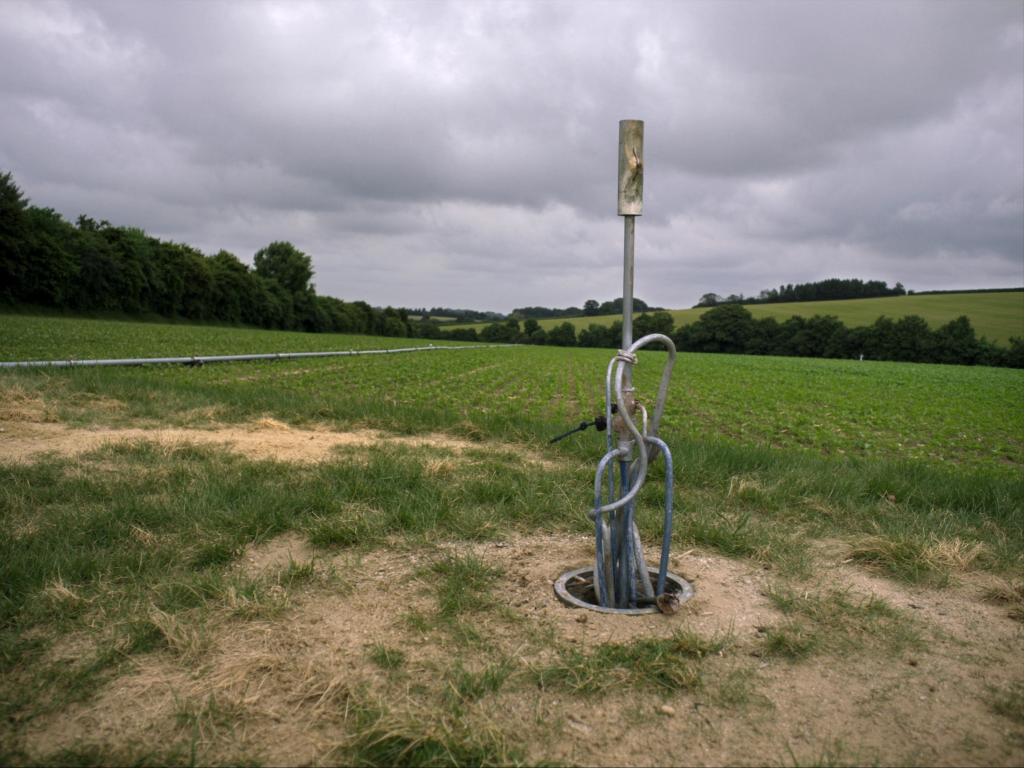
A borehole can cut your running costs to almost nothing once it’s drilled and tested. What it doesn’t do is remove the groundwork: you need a hydrogeological survey to confirm the aquifer can sustain your demand, a water quality test before you rely on it for anything sensitive, and — above a certain volume — an abstraction licence from the Environment Agency. We cover exactly where that threshold sits in the licensing section below.
Boreholes suit growers with consistent, high-volume demand where the upfront drilling and testing cost is paid back over years of near-free water. They suit intermittent, low-volume use less well, where mains or storage is often the simpler call.
Harvested rainwater and on-site reservoirs sidestep abstraction licensing almost entirely — you’re storing what falls on your own roofs and land, not taking it from a river or aquifer. The trade-off is that supply follows the weather, so the system has to be sized around your driest stretch, not your average rainfall. That’s a storage and capacity question as much as a water question — see our water storage solutions for how we size tanks and reservoirs against peak summer demand.

Before recommending a source, we look at five things: your current and future peak-day demand; what’s already available on site — mains connection, existing borehole, roof catchment; the cost and lead time of each realistic option; whether abstraction licensing applies, and if so, which licence type and how long it takes; and how the source interacts with your storage and pumping needs so pressure holds up when it matters.
Most commercial sites end up on a hybrid — mains or borehole for baseline supply, storage to buffer peak demand — rather than a single source doing everything.
In England, taking more than 20 cubic metres (20,000 litres) of water a day from a borehole, river or other natural source generally requires an abstraction licence from the Environment Agency. Below that figure, most abstraction is exempt. If you draw from the same source at more than one point, the combined total across all of them is what counts against the 20m³ limit — not each point individually.
There are three licence types: a full licence for ongoing abstraction of 28 days or more, which is protected in law against later licences affecting your supply; a transfer licence for moving water from one source to another without using it in between; and a temporary licence for abstraction over 20m³ a day lasting less than 28 days. Applications go through GOV.UK, and there’s an application charge that depends on licence type — the Environment Agency’s own guidance has current figures and timescales.
Rules differ slightly for Wales (Natural Resources Wales) and Scotland (SEPA), so if your site sits outside England, check with the relevant regulator directly. We’re not a substitute for that — what we do is design the system around whichever licence position applies to your site, and flag early in the design conversation if what you’re planning is likely to trigger the licensing threshold, so it isn’t a surprise partway through a project.
We’re a family-run Lancashire firm working with growers across the whole of the UK and internationally. We size systems around whichever water source makes sense for your site — mains, borehole, reservoir or a mix — and flag licensing considerations early, before they become a mid-project surprise.
Tell us your site, your crop and your peak demand, and we’ll talk through the realistic options. Call Simon on 07881 271 117, email simon@sitetech.uk, or get in touch to arrange a design visit.
In England, yes, if you’re taking more than 20 cubic metres (20,000 litres) a day from a borehole, river or similar natural source. Below that threshold, most abstraction is exempt. If you draw from the same source at several points, the combined total is what counts, not each point on its own.
20,000 litres sounds like a lot, but a modestly sized commercial glasshouse or a few hectares of field irrigation on a hot day can get close to it. It’s worth checking against your actual peak-day demand rather than your average — that’s part of what a design visit works out.
A full licence covers ongoing abstraction of 28 days or more and is legally protected against later licences affecting your supply. A transfer licence covers moving water from one source to another without an intervening use. A temporary licence covers abstraction over 20m³ a day for less than 28 days.
No — abstraction licence applications go through the Environment Agency (or Natural Resources Wales / SEPA outside England) directly via GOV.UK. What we do is design your system around the licence position that applies, and flag early if your plans are likely to trigger the threshold.
Rainwater harvesting and reservoir storage aren’t abstraction from a natural source in the same sense, so they generally sit outside the licensing regime. The trade-off is that supply depends on rainfall, so storage has to be sized around your driest period, not your average.
It depends on your peak-day demand and how much of the year you need water. High, consistent demand tends to favour a borehole once drilling and testing costs are paid back; occasional or low-volume use is often cheaper and simpler on mains or stored water.
It usually can, especially for propagation or lower-demand periods, but most commercial glasshouses need it paired with enough storage to cover dry spells reliably. We size that storage against your actual peak demand, not average rainfall.
Yes, if it’s not already been tested — flow rate and water quality both need confirming before you rely on a borehole for irrigation. We can advise on what testing to commission as part of a design conversation.
Timescales vary by licence type and catchment, and the Environment Agency’s own guidance has current figures — it’s worth checking before you commit to a project timeline that assumes borehole water from day one.
Yes. We design systems around mains, borehole, reservoir and rainwater sources — and combinations of them — for growers across the whole of the UK.